Direct answer
A treasury balance is an endpoint. Performance is a measurement conclusion. The two become dangerously easy to confuse when a DAO treasury receives capital, pays grants, executes buybacks, moves assets between wallets, changes scope, earns yield and holds volatile tokens during the same reporting period.
The practical fix is a reviewer’s Attribution Bridge: a period-specific reconciliation that starts with one clearly defined opening value, records non-overlapping economic components, keeps rebalancing and other non-additive actions separate, and leaves any unsupported difference as an explicit residual instead of inventing a story for it.
The bridge used here is:
V_close = V_open + F_capital + F_operating + I_investment + P_asset + P_FX − C_costs + A_scope/basis + U_unexplained
This is an author-defined analytical model, not a universal accounting journal and not formal factor attribution. Its value is discipline: every additive line needs a defined perimeter, sign, period, source and inclusion rule.
That discipline matters because three different questions are often collapsed into one:
- Value bridge: why did the marked treasury value change?
- Return measurement: what return did an investment sleeve earn after defining external flows, timing, valuation and costs?
- Performance evaluation: how did that return compare with an ex-ante mandate, benchmark and risk budget, and what—if anything—can be attributed to decisions or skill?
A complete value bridge may still be insufficient for question two. A verified return may still be insufficient for question three.
Scope first: define the thing being measured
Before touching the arithmetic, freeze the reporting perimeter. A wallet address is not automatically an organization. A manager mandate is not automatically the whole DAO treasury. Assets visible in a dashboard can include operational safes, protocol-owned liquidity, locked tokens, receipt tokens or balances that are intentionally outside a managed mandate.
For each case, record the reporting entity, included addresses or accounts, chains, ownership/control evidence, exclusions, start and end timestamps, timezone, reporting currency, price policy, accrual versus cash treatment, gross versus net basis and fee basis. If liabilities are not observable, describe the measure as gross marked assets rather than silently upgrading it to equity, solvency or audited NAV.
A scope change is also an economic event in the review file. If a wallet is added to reporting in August, the late discovery of its pre-existing balance is not August investment performance. It belongs in A_scope/basis or a restatement, with the old and new perimeter both disclosed.
Public-source case: KPK and CoW DAO
KPK’s 24 September 2026 treasury report is useful precisely because it shows why headline balances need attribution. It says its five DAO mandates rose from $132.29M at end-July to $151.74M at end-August, a 14.7% balance increase, while also reporting $332,520 of DeFi strategy yield in July and $375,142 in August. The same report says market recovery, especially ETH, was the dominant driver of the headline growth. These are manager-reported figures, not an independent performance audit.
There is an immediate period-control issue. The aggregate endpoints are end-July and end-August—one month apart—while the narrative combines July and August and reports yield for both months. A reviewer should not sum two months of yield against a one-month endpoint bridge. The correct response is not to guess a missing opening date. It is to flag the period mismatch and move to a mandate where the monthly reports expose more of the mechanics.
CoW DAO is the stronger public example, but it is still an unclosed review file, not a reconstructed performance record.
| Public line | July 2026 | August 2026 | Reviewer treatment |
|---|---|---|---|
| Opening reported AUM | $26.54M | $24.44M | Manager/governance reported |
| External flow within the managed-mandate boundary | −$3.15M USDC withdrawal on 9 July | +$0.516M inflows | Additive only for this mandate boundary; whole-DAO treatment may differ |
| Market / marked-position effect | Source says +$0.854M gain excluding July transfer, driven by ETH and staked marks | +$1.15M mark-to-market gains | Inclusion definitions still matter |
| DeFi strategy yield | $73,361 | $77,342 | Analytical cut; not added again without proof it is outside the marked gain |
| Closing reported AUM | $24.44M | $26.11M | Manager/governance reported |
| Calculated unresolved residual | +$1.05M using only the confirmed −$3.15M flow; +$196k sensitivity if the reported +$854k gain is treated as an inclusive performance line | +$4k if August $1.15M mark-to-market already includes reported DeFi results | Keep visible; do not call it alpha, market effect or rounding without evidence |
| Verified investment return | Not measurable from reviewed public inputs | Not measurable from reviewed public inputs | Flow/valuation timing and fee/yield inclusion are incomplete |
The July report says the AUM decline was “almost entirely” the $3.15M transfer, and that excluding the transfer the portfolio gained $854K, driven by ETH and staked-position marks. With only the confirmed external-flow line classified, the bridge therefore retains a +$1.05M unexplained residual. Treating the separate +$854K sentence as an inclusive performance component is a sensitivity that reduces the residual to +$196K; it is not a proven pure market-price line. The report also states $73,361 of DeFi strategy yield, but the public text does not establish whether that yield is wholly inside the $854K, partly inside it, or an additional line. Adding it automatically would be a classification choice, not a source fact.
August is cleaner but still not complete. The report says the move from $24.44M to $26.11M reflected $1.15M of mark-to-market gains plus $516K of inflows. Those two lines sum to $1.666M against a rounded endpoint change of $1.670M, leaving $4K. The same report separately states $77,342 of DeFi results. Adding that yield on top of the $1.15M without an inclusion definition would overshoot the endpoint bridge. The safer reading is that the yield line is an analytical cut of performance already represented in the marked value, unless a source proves otherwise.
There is another scope warning in the source chain. KPK’s June aggregate blog calls the CoW treasury $32.7M NAV, while the CoW DAO forum’s June monthly report gives $26.54M total AUM, split between a $21.98M Core Treasury Mandate and a $4.57M Defence Reserve. The July forum report uses $26.54M as its prior-month comparator. The reviewed pages do not reconcile the $32.7M versus $26.54M perimeter, so this article does not merge them.
That is what a useful public review file looks like when data are incomplete: it exposes the unresolved field instead of manufacturing a closed waterfall.
A reproducible synthetic bridge
To show the full method without pretending that missing public data exist, use a separate synthetic case.
Synthetic case SYN-001. A fictional DAO treasury starts January with $10.000M of unlevered gross marked assets. During the month it receives a $2.000M capital contribution, makes a $300k operating grant payment, earns $40k of investment income, experiences $540k of asset-price appreciation, records $10k of FX effect, and incurs $30k of transaction/management costs. It also performs a $1.0M internal USDC-to-ETH rebalance; the swap itself is non-additive, while its $2k fee is included in costs.
| Bridge component | Signed amount | Classification |
|---|---|---|
| Opening marked assets | $10,000,000 | V_open |
| Capital contribution | +$2,000,000 | F_capital |
| Operating grant | −$300,000 | F_operating |
| Investment income | +$40,000 | I_investment |
| Asset-price effect | +$540,000 | P_asset |
| FX effect | +$10,000 | P_FX |
| Costs | −$30,000 | C_costs |
| Scope/basis adjustment | $0 | A_scope/basis |
| Unexplained residual | $0 | U_unexplained |
| Closing marked assets | $12,260,000 | V_close |
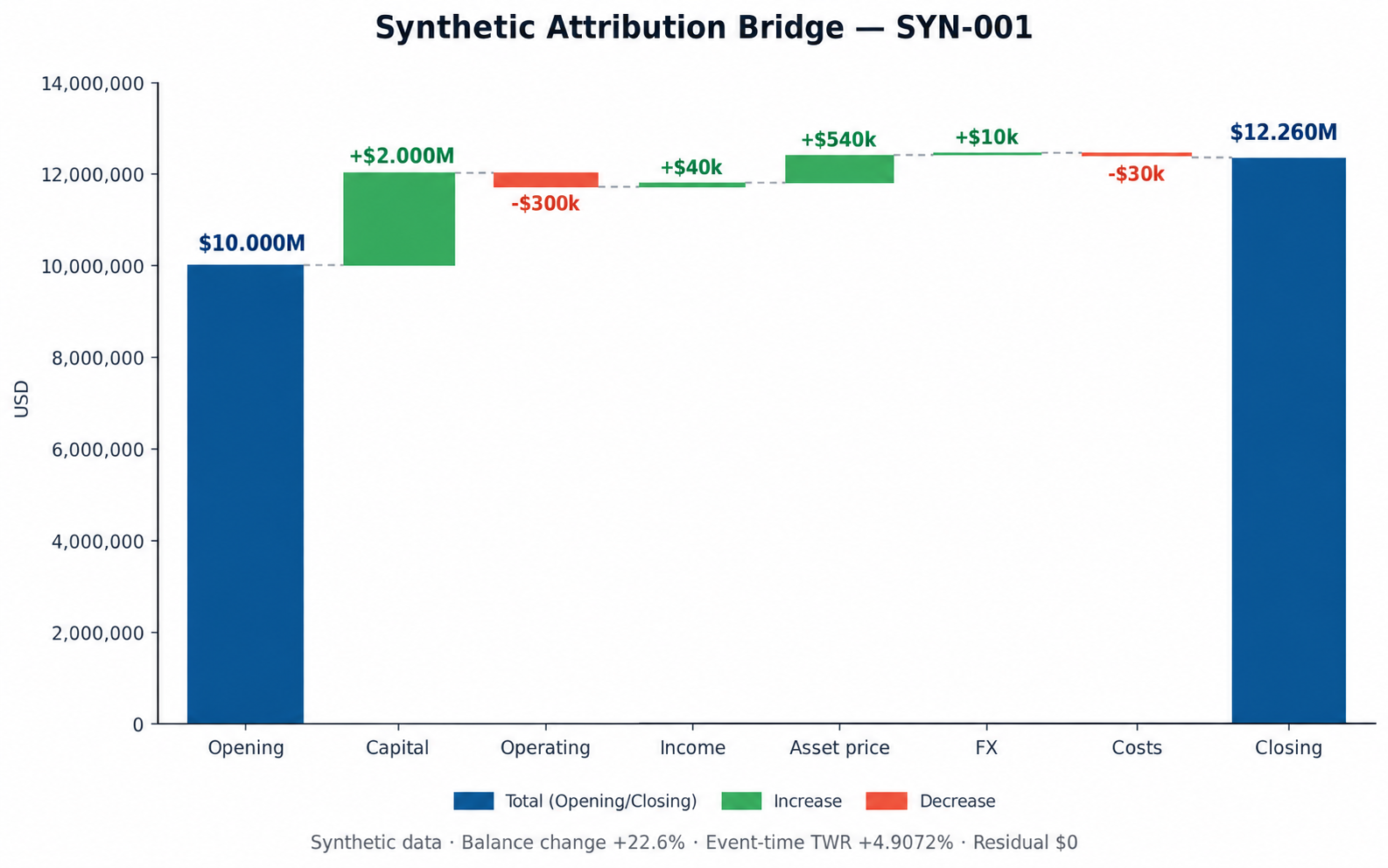
The raw balance change is +22.6%. That is not the synthetic investment return because the balance includes a $2.0M contribution and a $300k operating outflow.
The event ledger contains marks immediately before the two flows that are external to the synthetic investable sleeve. Geometrically linking the three subperiod returns produces an exact synthetic TWR of 4.9072% for the stated event-time data. A full-period Modified Dietz calculation using an explicit end-of-day calendar-date weighting convention produces 4.8397%. That Dietz number is intentionally labelled an estimate: it does not become exact TWR merely because it is close.
The same event can change classification when the perimeter changes. The $300k grant is an operating outflow in the whole-treasury value bridge. For an investable sleeve whose mandate ends when funds are withdrawn for operations, it is an external flow for return measurement. The label “external” is therefore incomplete unless the reviewer also names the perimeter and the question.
Six double-counting traps
1. Internal transfers and swaps. Moving USDC from one in-scope wallet to another does not create a contribution. Wrapping an asset, bridging it with a properly evidenced in-transit claim, depositing into a vault, or swapping USDC for ETH does not create a new economic asset on top of the old one. Rebalancing belongs in an action note; fee, slippage and later revaluation belong in additive lines.
2. Realised P&L versus the opening mark. If an asset cost $80 historically, was worth $100 at the opening mark and was sold for $110, the current-period gain is $10—not the $30 lifetime gain. Adding $30 to a bridge that already starts at $100 counts $20 twice.
3. Vault shares plus underlying. ERC-4626 defines vault shares as claims on underlying assets, and totalAssets is designed to include managed underlying and compounding yield. A review model must choose an economic unit and avoid summing receipt tokens and underlying twice. A displayed APY is not earned period income, and vault fee semantics must be checked rather than assumed.
4. Yield plus share-price appreciation. If a yield-bearing share moves from $100 to $105 because earnings compound inside the share value, recording both the $5 mark increase and another $5 “yield” line creates a $10 gain from a $5 economic change. The KPK/CoW public case illustrates exactly why inclusion definitions matter.
5. Buyback plus burn. A cash-funded buyback needs both sides: cash out and the fate of the acquired token—retained, burned, distributed or unknown. A subsequent burn is not a second copy of the cash payment. If the treasury’s own token is included in the value basis, its treatment requires an explicit policy; a self-issued token mark is not the same as spendable cash.
6. Debt principal plus expense. Borrowing $1M can increase gross cash by $1M and liabilities by $1M without creating net wealth. Principal repayment is financing, not negative investment income. Interest or another economic cost is a separate expense. Accruing a liability and later settling it should not reduce the same net metric twice.
When can you measure return?
A return method should be selected from the evidence, not from the desired headline.
- Only endpoint values, without reliable flow history: report balance change and a value bridge. Do not call
(close − open) / openinvestment return when material flows occurred. - Reliable flow dates plus valuations around flows: a time-weighted return can be built using consistent subperiod conventions and geometric linking.
- Dated flows but no necessary intra-period valuations: Modified Dietz can be a transparent estimate when its assumptions fit. The GIPS methodology discussion is useful here because it explains both the weighting logic and why the estimate is less accurate than valuing at each external flow. This article does not claim GIPS compliance for a DAO, KPK or the model.
- Money-weighted return / IRR: use it only for the question it answers, with a complete flow history and terminal value. Non-conventional cash-flow patterns can produce no root or multiple roots; a reviewer should not choose the convenient root.
Valuation policy is part of the return method. GIPS guidance emphasizes consistent valuation policy and warns against opportunistic valuation around cash flows. For digital assets, the reviewer should also document price source, timestamp, FX source, stale-price handling, token decimals, claims/receipt-token treatment and whether accrued rewards are inside the mark.
From return to performance evaluation
Even a correct TWR is not a verdict on treasury management. Formal evaluation needs an ex-ante mandate or benchmark with compatible currency, universe, weights/rebalancing rules, fee basis, risk assumptions and period. A benchmark chosen after the result is known is not a neutral yardstick.
And excess return is not automatically skill. The reviewer still needs to ask what risk was taken, what exposures drove the result, whether decisions were within mandate, what liquidity and operational constraints existed, and whether the observed result is statistically or economically informative. The Attribution Bridge in this article stops before making those causal claims.
The reusable review file
The upstream editorial brief proposed 14 fields. Keep all 14, but do not mistake them for 14 waterfall bars.
Download the review materials: Review File Template (.txt) · Worked Example (.txt)
Additive/value fields: opening market value; net contributions/withdrawals; market-price effect; strategy income/yield when not already embedded elsewhere; realised P&L only under a non-overlapping convention; fees/transaction costs; grants/operating disbursements; buybacks where they are genuinely an economic outflow under the chosen perimeter; closing market value.
Non-additive/action fields: rebalancing/position changes, transaction links and operational notes. These explain decisions and holding intervals but are not automatically sources of value.
Control/metadata fields: exceptions/source limitations; source timestamp; reviewer; next review date.
Then add the fields the reviewer needs to prevent ambiguity: exact scope, reporting basis, period and price policy, event IDs, evidence status, return eligibility, residual, outstanding questions and reviewer disposition. Reviewer and next-review fields should remain blank when nobody has actually been assigned.
The central control is simple: unknown is a valid result. If U_unexplained is material, preserve its sign and magnitude. Do not rename it “market effect,” “alpha,” “rounding,” or “miscellaneous” unless evidence supports the classification.
What this bridge does—and does not—prove
A good bridge can prove arithmetic consistency under a stated perimeter and classification policy. It can show which published lines do not reconcile. It can identify missing flow dates, unclear fee treatment, stale or conflicting scope and double-counting risk. It can make a subsequent return calculation reproducible when the necessary data are present.
It cannot certify that every wallet belongs to the entity, that every valuation is correct, that liabilities are complete, that a smart contract is safe, that a manager acted appropriately, or that a DAO should choose a particular strategy. It is not an audit opinion, accounting conclusion, GIPS verification or investment recommendation.
That limitation is a feature of the method. A reviewer should be able to say, “the balance moved, these components are supported, these are still missing, and therefore this is the strongest conclusion the evidence permits.”
If your treasury report cannot make that sentence easy to reconstruct, start with the review file before adding another performance headline.
What this does not prove. An arithmetic bridge can explain how a reported opening value connects to a reported closing value. It does not, by itself, prove investment return, manager skill, suitability, accounting correctness, audit assurance, protocol safety or benchmark outperformance.
Sources and methodology
Primary/public reporting anchors reviewed 4 October 2026:
- KPK, Treasury Report: July and August 2026 — https://kpk.io/blog/treasury-report-july-august-2026
- KPK, Monthly Treasury Report: June 2026 — https://kpk.io/blog/monthly-treasury-report-june-2026
- CoW DAO, July 2026 Monthly Report — https://forum.cow.fi/t/cow-dao-treasury-july-2026-monthly-report/3532
- CoW DAO, August 2026 Monthly Report — https://forum.cow.fi/t/cow-dao-treasury-august-2026-monthly-report/3573
- CoW DAO, June 2026 Monthly Report — https://forum.cow.fi/t/cow-dao-treasury-june-2026-monthly-report/3494
- CoW DAO, Core Treasury Team — Scope and Strategy Update — https://forum.cow.fi/t/core-treasury-team-scope-and-strategy-update/3250
- CoW DAO, CIP-62: Core Treasury team mandate and funding — https://forum.cow.fi/t/cip-62-core-treasury-team-mandate-and-funding/2770
Method references:
- CFA Institute, GIPS Standards Handbook for Firms — https://www.gipsstandards.org/standards/gips-standards-for-firms/gips-standards-handbook-for-firms/
- Ethereum Improvement Proposals, ERC-4626: Tokenized Vaults — https://eips.ethereum.org/EIPS/eip-4626
- Treasury Desk methodology — https://treasurydesk.io/methodology/
- Treasury Desk product boundary — https://treasurydesk.io/legal-scope/
The bridge equations, event taxonomy, synthetic case, review template and reviewer questions are Treasury Desk author synthesis for educational review use. Public KPK/CoW figures are manager/governance reported and were not independently audited in this research run.
Reviewer control: Unknown is a valid result. Keep a material unexplained residual visible until evidence supports a classification.
Prepared 4 October 2026. Public KPK/CoW figures are manager/governance reported and were not independently audited in this research run. Synthetic case SYN-001 is fictional and separate.